Discover 21st Century Laser-free Confocal Microscopy
Overview
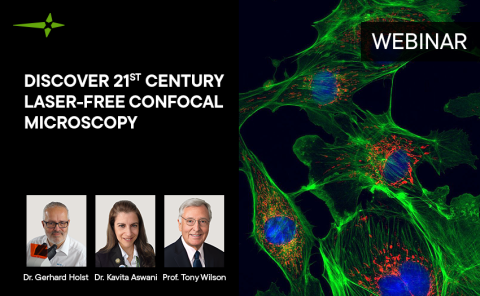
Confocal Microscopy is valued for its ability to capture thin, high-resolution, in-focus slices from deep within thick specimens. These optical sections improve image contrast, remove out of focus fluorescence which blurs the images, and can be reconstructed into 3D models.
The first confocal design, proposed by Marvin Minsky in the 1950s, used a point illumination–point detection system that naturally rejects out-of-focus light. To build images, the system required point-by-point scanning, a powerful laser light source, and sensitive detectors such as PMTs to compensate for weak signals. This design became feasible in the 1970s and was typically added onto conventional microscopes.
Since then, technological advances have introduced alternative approaches. CCD cameras, non-laser light sources, and computational image processing now make it possible to achieve optical sectioning without relying solely on lasers, single pinholes and PMTs.
In this webinar, we will discuss a modern technique which combines structured illumination with sensitive structured detection, enabling the production of thin, high-contrast, high-resolution optical slices similar to traditional confocal imaging, but with simpler, more flexible instrumentation, based on new LED light sources, advanced aperture correlation methods and a sensitive high resolution sCMOS camera.
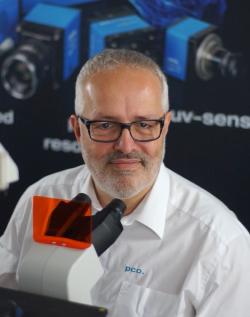
Gerhard Holst graduated at the Technical University Aachen, Germany, with a Diploma in Electrical Engineering in 1991 (Information Technology) and went on to complete his Doctorate at the University of Dortmund in collaboration with the Max-Planck-Institute for Systemphysiology in Dortmund, Germany from 1991 - 1994. Gerhard furthered his research as member of the Microsensor Research Group at the Max-Planck-Institute for Marine Microbiology in Bremen, Germany from 1994 – 2001. From 2001 – 2021 Gerhard was head of the research & science department at PCO AG, where he was responsible for new technologies, research and sensor projects, including the development of sCMOS image sensors. Since the acquisition by Excelitas in September 2021 Gerhard has become Senior Imaging Product & Application Scientist and is responsible for some of the advanced sCMOS camera systems, as well as the FD-FLIM and SWIR cameras and research projects.

Dr. Kavita Aswani serves as the Senior Applications Scientist for BioMedical products at Excelitas Technologies. With a Ph.D. earned from the University of Iowa, she boasts an extensive background, encompassing 7 years of scientific research expertise and over 25 years of applications experience in the fields of microscopy and fluorescence industry. Throughout her career, Kavita has contributed to numerous publications and peer-reviewed journal articles. Her specialized areas of work include widefield illumination microscopy, laser scanning microscopy, and flow cytometry. She remains an engaged member of both the Society for Neuroscience and the Royal Microscopical Society.
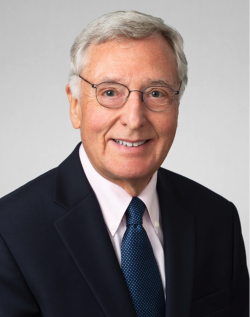
Tony Wilson is Chairman and CEO of Aurox Ltd., which manufactures a number of confocal imaging systems. He is a former Professor of Engineering Science at the University of Oxford and Senior Fellow of Hertford College in the UK, and is internationally known for his pioneering contributions to confocal microscopy. He began working in the field before the term ‘confocal’ was coined, wrote the first book on the subject in 1984 and has since introduced a number of new imaging modes and novel approaches to optical sectioning, a critical component to imaging thick specimens. His achievements have been recognized with numerous awards, including the Prince of Wales Award for Industrial Innovation and Production and the Queen’s Award for Enterprise.
Tony was editor of the Journal of Microscopy for over twenty years and has been President of the Royal Microscopical Society, of which he is an honorary Fellow. He has served as Master of the Worshipful Company of Scientific Instrument Makers in London and was elected to a Fellowship of the Royal Academy of Engineering, the equivalent of the National Academy of Engineering in the United States.
Discover 21st Century Laser-free Confocal Microscopy